Solar thermal turns free solar energy into comfort in your home.

The efficient partner for sustainable heat generation.
Solar thermal offers an effective way to support heating systems sustainably and reduce energy consumption. By harnessing solar energy, it contributes to eco-friendly heat production. However, due to its reliance on sunlight, seasonal variations and limited storage capabilities, it's generally not suitable as a sole heat generator.
Solar heating
Advantages of solar thermal systems.
- Government subsidies.
Government grants provide financial support when you choose to install a solar thermal system.
- Save costs and energy.
The solar system supplies up to 60 percent of the energy for hot water production and up to 30 percent for heating, reducing your energy costs.
- Sustainability.
Solar thermal harnesses the free, emission-free, and virtually inexhaustible energy of the sun, decreasing your reliance on fossil resources like gas and oil.
- High efficiency in compact spaces.
Both flat-plate collectors and vacuum tube collectors achieve high yields even in limited spaces, allowing you to benefit from good returns even on small roofs.
Vaillant tip: understand the difference of solar thermal vs. photovoltaic.
Solar thermal uses solar energy to generate heat, which is used for hot water production and heating.
Photovoltaic, on the other hand, converts sunlight directly into electricity, which can be used to power a heat pump as well as meet general energy needs.
Operating principle
How solar thermal works.
- 1/3
Within the solar collectors, a solar fluid circulates, absorbing the sun's warmth.
- 2/3
It then transfers it via pipes to the solar storage unit.
- 3/3
There, it transfers the sun's heat to your hot water. Additionally, a solar combination or multifunctional storage unit provides heat to the heating device, reducing its workload. This means you can lower your regular heating energy costs with solar thermal energy.

Use cases
Solar thermal for heating.
Solar thermal systems are excellent for supporting your heating needs.
The solar fluid circulating in the collectors and pipes, heated by the sun, flows through a heat exchanger, transferring warmth to a buffer storage tank. The heated water can then be directly integrated into the heating system.
Typically, this integration is achieved through a return flow elevation of the heating circuit. In heating support applications, solar thermal systems usually achieve a solar coverage rate of about 25 to 30 percent. This means you can save this portion of your conventional heating costs using free solar energy.

Solar thermal for hot water production.
Alongside heating support, a solar thermal system can also provide hot water. In solar hot water production, the solar fluid heated by the sun is transported directly to the lower heat exchanger of the solar storage tank using a circulation pump.
Here, it transfers heat energy to the stored potable water. If sunlight isn't sufficient to heat the domestic water, the primary heating system (like a gas boiler) raises the water to the desired temperature.
Solar thermal systems can cover an average of 60 percent of hot water production annually.
Different types
What types of solar collectors are there?
- Flat-plate collectors
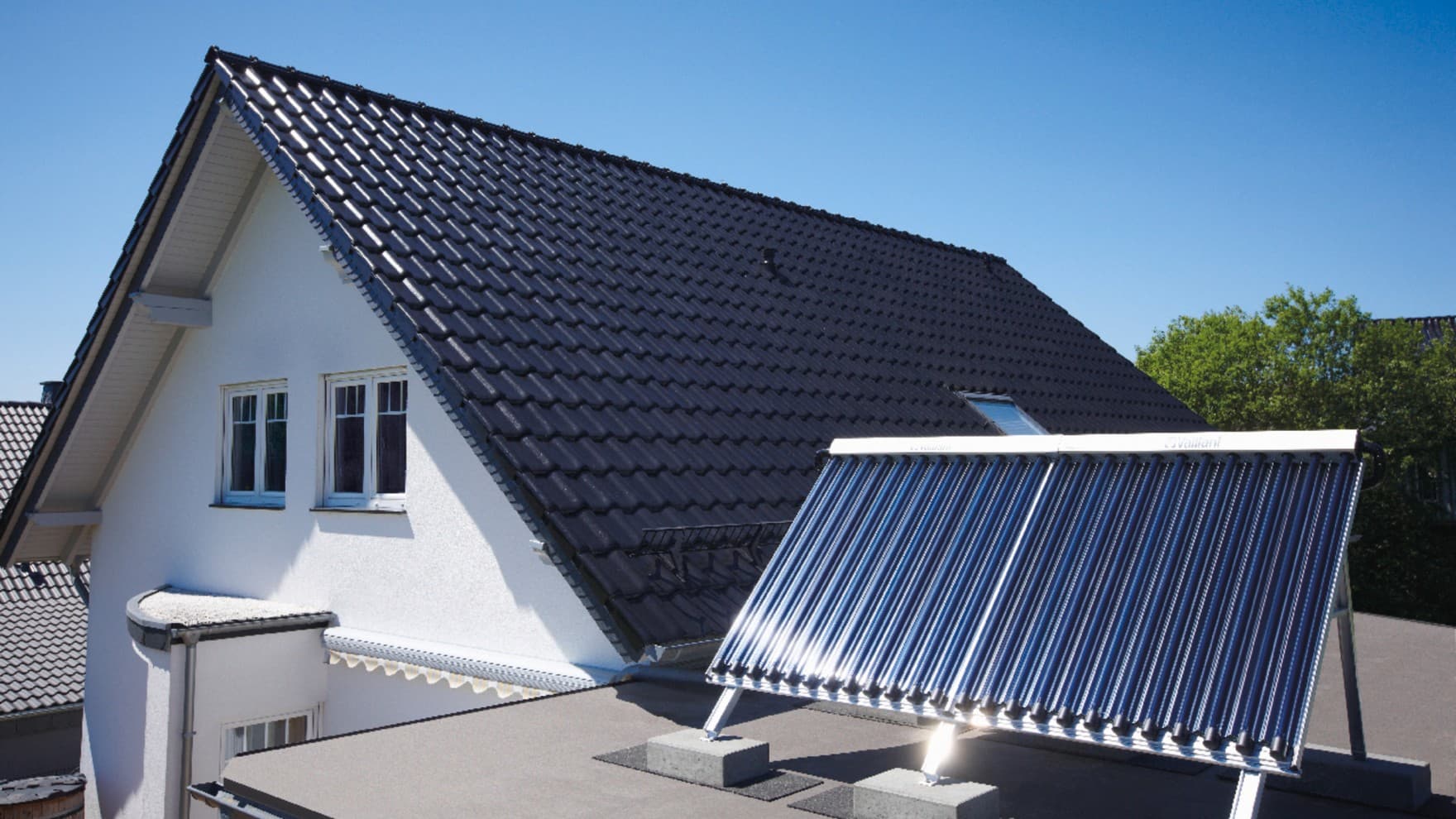
- Vacuum tube collectors
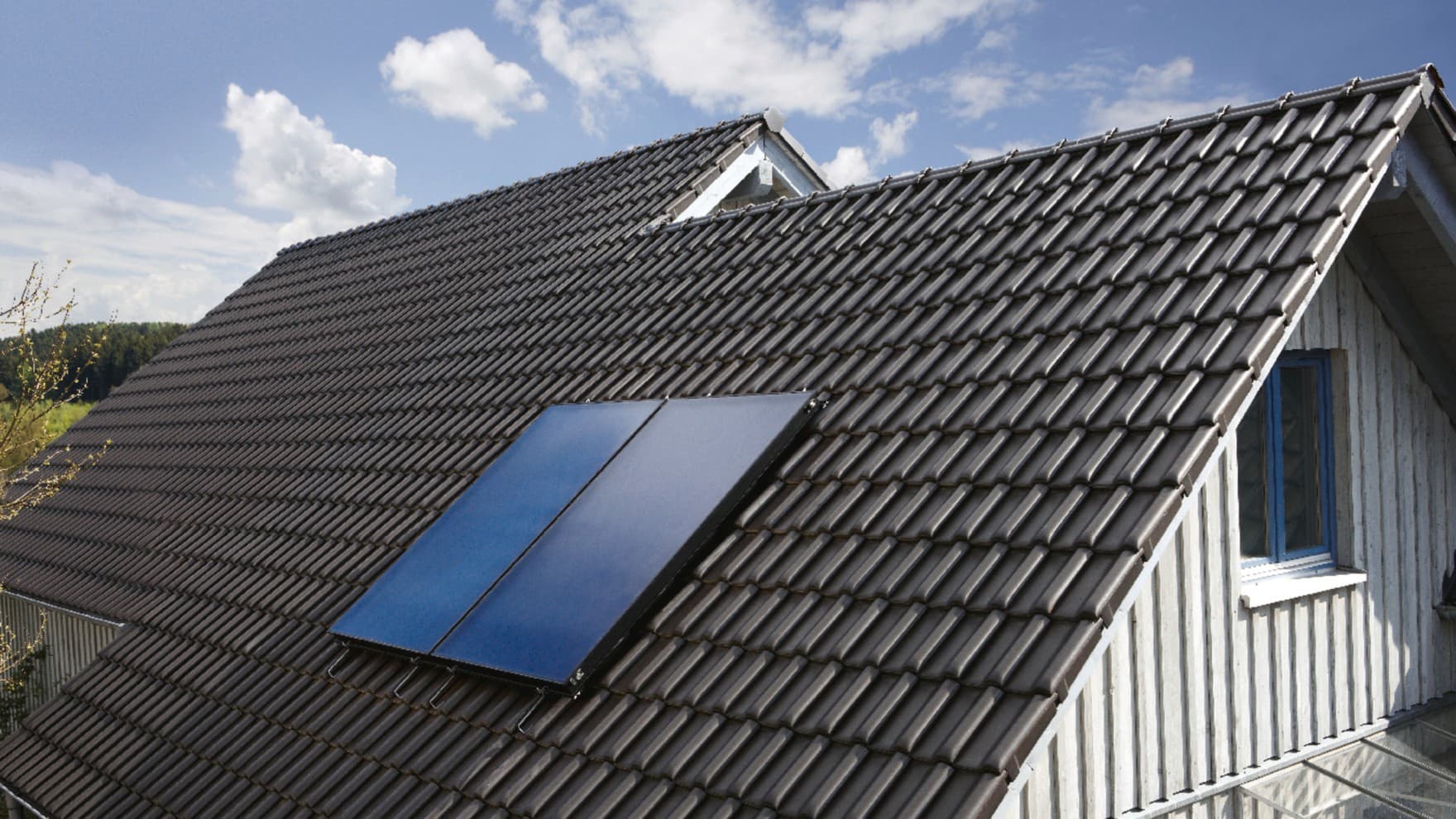
The main feature of a flat-plate collector is the black absorber surface, directly oriented towards the sun. This surface is designed and coated to absorb maximum sunlight and energy.
With their slimline height of only 80 mm, our auroTHERM flat-plate collectors integrate seamlessly into any roof. Our auroTHERM collectors, with their durable structured glass, offer a reliable and cost-effective entry into solar thermal technology.
The auroTHERM plus collectors boast anti-reflective glass technology and high-quality sidewall insulation, enabling excellent heat transfer.