Everything you need to know about water-source heat pumps.

Drawing in free environmental energy in to provide heat, hot water and even cooling in a sustainable, cost- and resource-saving manner all around the year: This is exactly what our water-source heat pumps do like no other heat pump type. Thanks to the far more constant temperature of groundwater compared to soil and air, running a water-source heat pump is the most efficient of all types.
Advantages of water-source heat pumps
Water-source heat pumps: a glance at benefits and drawbacks.
- Gain independence and sustainability.
Your house is heated in an environmentally friendly way by using thermal energy from groundwater.
- Keeping the cost down.
Water heat pumps have low operating and maintenance costs.
- Three in one.
A water-source heat pump provides heating, cooling and the comfort of hot water.
- Requires little space.
Vaillant water heat pumps require only a small space in your home.
Please be aware: Compared to other heat pumps, the water-spurce heat pump has comparatively high initial costs due to intensive planning. The installation through two boreholes is time-consuming. But once the investment is completed, you will benefit from the advantages for many years.
The operating principle of an water-source heat pump
How do water-source heat pump work?
Water-source heat pumps tap thermal energy stored in the groundwater by means of two wells: a suction well and a discharge well. With these, the heat pumps can heat and cool.
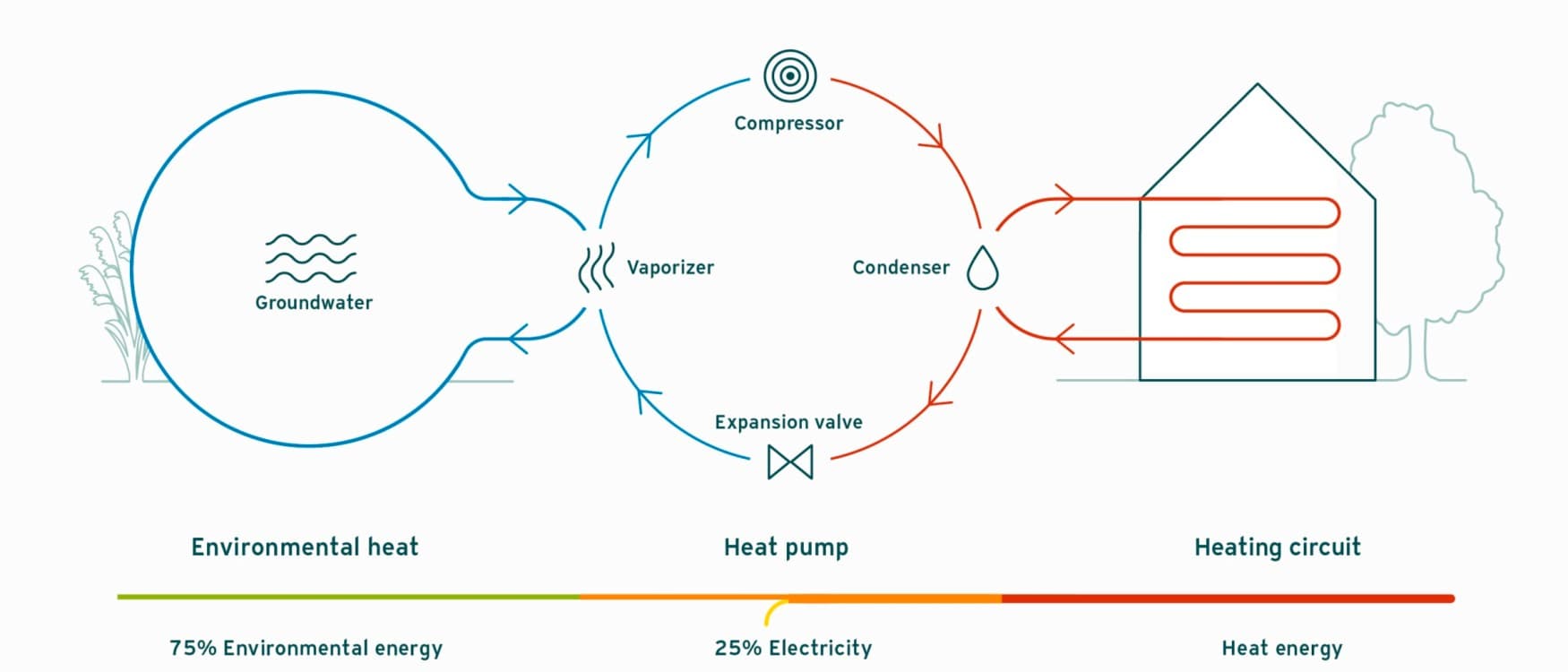
From the suction well, a pump transports groundwater to an evaporator inside the heat pump. The evaporator passes the groundwater heat on to a liquid refrigerant, causing it to evaporate. This vapour is now compressed and heats up further until it becomes gaseous, and the contained heat is fed into the heat exchanger.
From here, the heat is either passed on directly to radiators or underfloor heating and the domestic water production, or to a buffer storage that supplies the heating system.
The water from which heat was extracted is then led out into the discharge well. The refrigerant passes the heat onto the heating system and re-liquifies. It then reaches the expansion valve that regulates pressure inside the heat pump unit. At the expansion valve, the refrigerant cools down until it can absorb groundwater heat again and the supply loop thus closes.
Types of water-source heat pumps
Closed or open loop system: know the difference.
- Closed loop
- Open loop
The optimal condition for a closed loop water source heat pump is a property with sufficient water nearby. In this system, the necessary pipes are laid underground and in the water. The advantage: due to the simple installation, this variation is more cost-effective than the open loop system.
Suitability check
Does a water heat pump suit my house?
- Water qualityThe first thing to clarify is what the existing water quality is like - the water authority or a geologist can tell you about this.
- Groundwater sourceThe groundwater source should be at a maximum depth of 15 meters for lower construction costs and lower electricity consumption of the well pump.
- Official permitsA permit must be issued by the competent authority. Before the construction can begin, the approved application documents must be submitted. This can take at least one month.
- Individual factorsFor individual questions simply contact a Vaillant specialist heating contractor who will inform you about all the necessary documents or sorrounding factors.

First steps & preparations
Planning your water-source heat pump.
- Know the area where you want to drillYou’ll have to make sure that you don’t live in a water conservation area where operating a water-source heat pump is generally prohibited.
- Obtain a permission for drillingThe drillings depth is ideally at around 15 metres or less and crucial to the heat pump’s efficiency. The construction of wells with less depth is much cheaper, too. The ideal diameter for the well is determined by the amount of water that must be continuously available to ensure an adequate supply to your home.
- Have a test drillingThe first is a test drilling to analyse the concentration of oxygen and solids like manganese and iron in the groundwater – if results are too high, substances in the groundwater may cause deterioration of the heat pump.
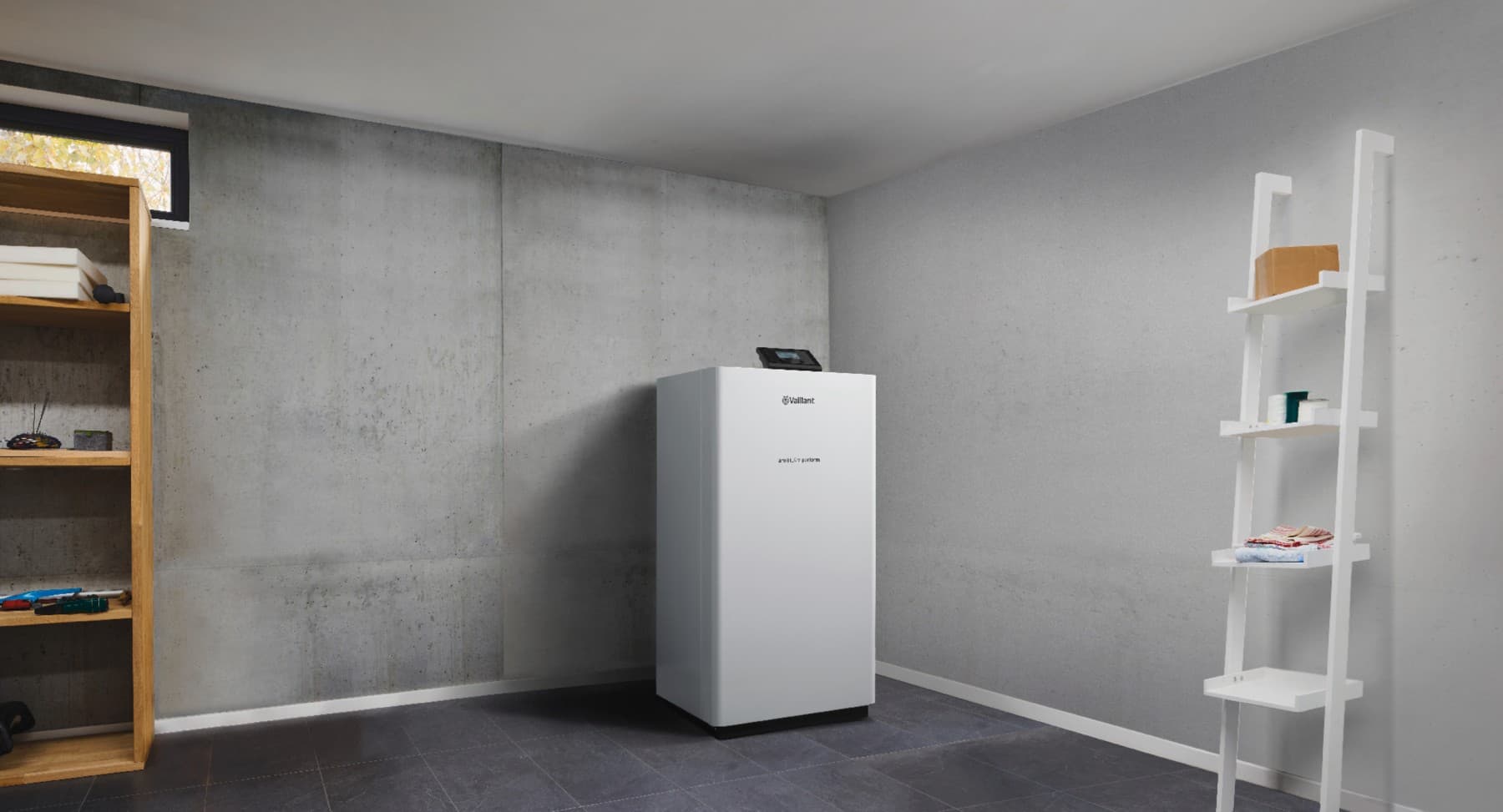
- Find the perfect place for your heat pumpYour water-source heat pump should ideally be installed in your home's utility room. This also makes for a very space-saving solution, as the heat pump doesn’t require any more space than a regular refrigerator.
Additional benefit of water-source heat pumps
Cooling with a water-source heat pump.
Another major advantage of water-source heat pumps is their ability to provide comfortable indoor cooling during hot summer periods.
To achieve this, the refrigeration cycle is simply reversed – meaning that heat inside the building is directly passed to the ground water via an additional heat exchanger.
As this type of passive cooling doesn’t employ the heat pump’s compressor it also hardly requires any electrical input. This makes it a highly cost-efficient heat pump cooling method, but also limits its cooling capacities.