Cooling explained: how your heat pump works in summer.

Advantages of cooling with a heat pump
Nature's way to stay cool.
- Comfortable indoor climate.
Heat pumps cool by tempering floors or via fan coils on the ceiling or wall, creating a pleasant indoor environment without draughts.
- Environmentally friendly.
By using eco-friendly electricity and natural refrigerants such as R290, our heat pumps are sustainable and CO₂-neutral, which reduces the environmental impact.
- Cost-effective solution.
With a heat pump, you can avoid the extra costs of installing air conditioning, as the conditions for cooling with a heat pump are often already in place.
- Integrated functionality.
Heat pumps provide cooling, heating, and hot water, ensuring comfort in every season with one versatile system.
How cooling with a heat pump works
Cooling with a heat pump - how it works.
In cooling mode, the heat pump cleverly reverses its heating process. By extracting warm air from your home and releasing it outside, a refreshing indoor climate is created. There are different cooling proccesses that are used depending on the energy source: active cooling, which actively removes warmth, and passive cooling, which uses the earth's natural coolness with minimal energy use. Discover more about each method below.
- Active cooling
- Passive cooling
Active cooling with a heat pump.
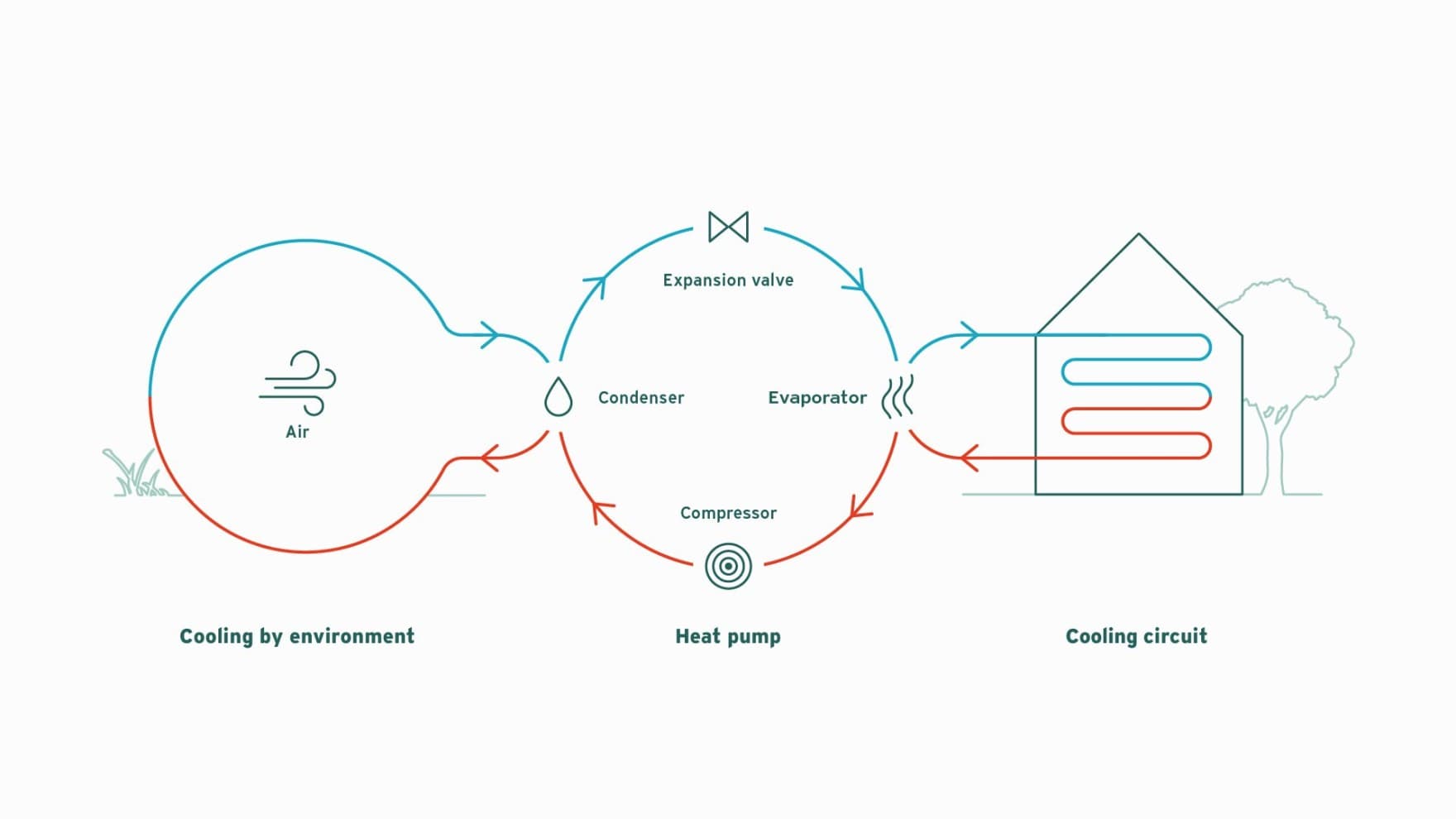
As mentioned before, your heat pump works by drawing warm air from the environment, leading it through a system of pipes – and finally transferring this heat to the heating circuit of your home.
When it comes to active cooling, the heat pump works in a similar way to heating, just in reverse. This means that warm air is extracted from your home and discharged into the environment. In this way, the temperature inside can be lowered by up to 3°C, either with underfloor heating or with a fan coil unit. It should be mentioned that the heat pump does consume energy during active cooling.
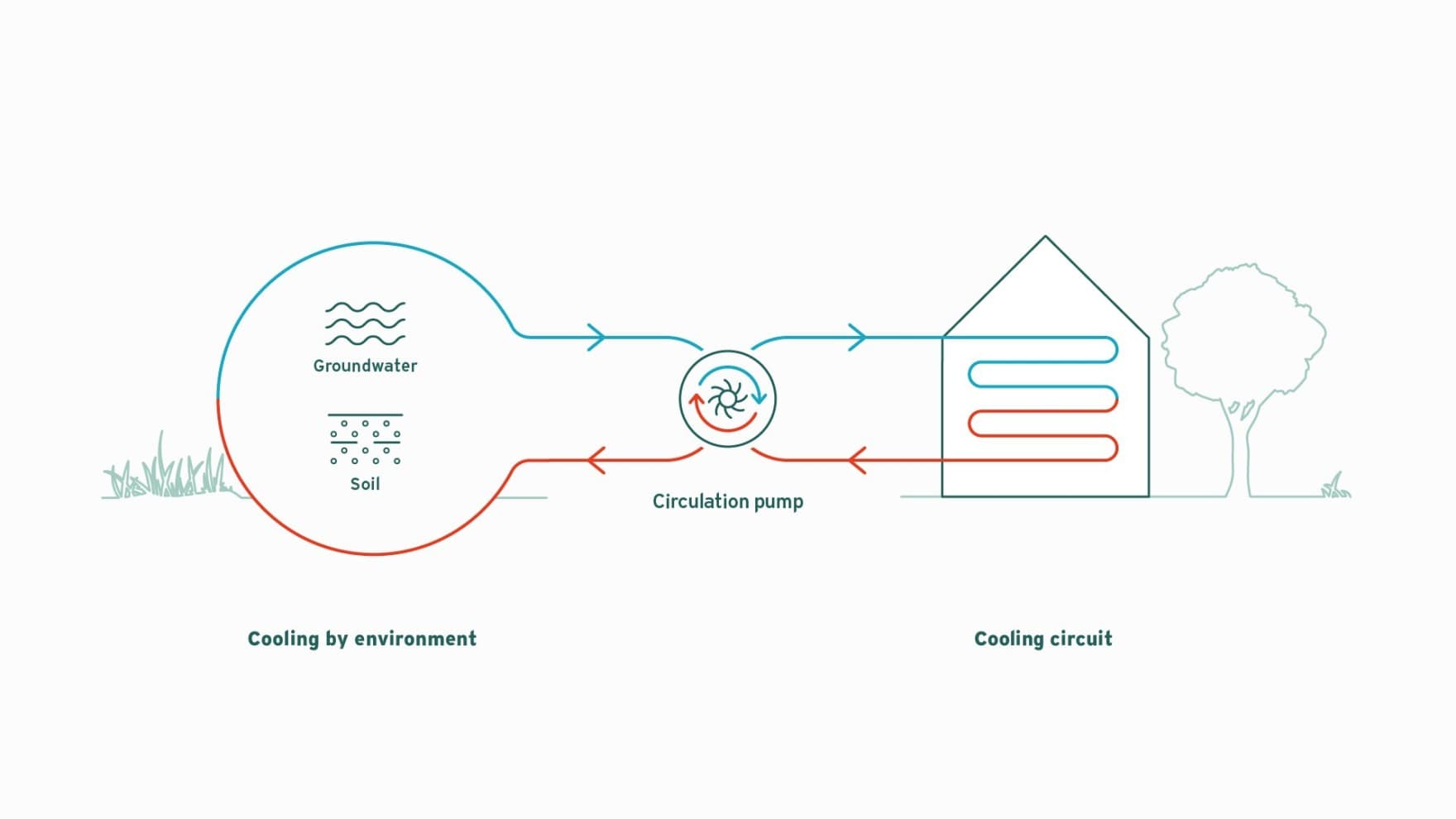
Active cooling is only possible with an air-source heat pump. With the water source and the ground source heat pump, active cooling is not possible.
Cooling options
Two ways to beat the heat.
Cooling with a heat pump can be achieved through two specific ways: underfloor heating and fan coil units. Each offers a distinct option to maintain a comfortable home temperature. Underfloor heating provides a silent, draught-free cooling experience, while fan coil units offer robust cooling with added dehumidification. It's important to note that conventional radiators are not suitable for cooling due to insufficient surface area.
For these cooling options to work effectively, certain conditions must be met. Besides having the appropriate heating surfaces, a dew point control system is essential. This system prevents moisture issues by maintaining a supply temperature that avoids condensation, protecting your home from potential damage and ensuring efficient heat pump operation.

How underfloor heating can help you to keep your cool.
As you know, with underfloor heating a system of pipes carrying water run beneath the floor in your home. During heating mode, warm water circulates and heats your rooms to the desired temperature. To cool things down, the whole process is reversed:Cold water is circulated and carries away the excess heat. This cooling method allows you to reduce the room temperature by up to 3°C. Cooling with this surface heating method comes with a number of advantages: it’s completely noise free to operate, there’s no need for an additional air conditioning system and draughts become a thing of the past. You only need to ensure that the temperature of your underfloor heating is monitored by sensors to prevent condensation occurring.


Boost your heat pump's efficiency with fan coils.
A fan coil unit is basically a kind of air conditioner. It consists of two components: a heat exchanger, which converts the thermal energy and a fan. Afan coil unitmakes use of cold water to cool the air down and the fan in turn blows it into the room. This is a particularly effective way to cool your interiors: the resulting cooling effect is greater than that achieved with surface heating method. Not only does the fan coil unit bring welcome relief on a hot summer’s day – it offers the additional benefit of dehumidifying the air.
It’s important to note that fan coils can only be used in combination with air source heat pumps.
Energy costs for cooling
Energy savings that give you a warm feeling.
With energy costs on the rise, heat pumps offer an efficient and timely solution with calculable running costs that are not only cost-effective, but often outperform conventional air conditioners. By combining heating and cooling, you reduce the need for separate units, lowering both installation and operational expenses. Passive cooling further cuts energy use, as it doesn't require constant operation of components. Plus, the reversible process allows for heat reuse in water heating, boosting efficiency.
If you want to keepoperating costs as low as possible, combining your heat pump with a photovoltaic system isan excellent option. It allows you generate the environmentally-friendly electricity that you need for the active cooling function of the heat pump. And there are no additional costs for electricity. Now that’s a cool idea!