Refrigerants: the flow that fuels your comfort.

Function of refrigerants
What is a refrigerant?
Refrigerants are substances that efficiently transfer heat and are used in many everyday devices. They are essential for heat pumps, which use them to transfer environmental heat into homes to provide heating and hot water. Air conditioning units also rely on the same principle and refrigerant use.
Refrigerants absorb heat from the surroundings through a heat exchanger and release it into the heating system through another heat exchanger. Refrigerators and air conditioners also use refrigerants, but they work in reverse, moving heat from inside the fridge or house to the outside.
Types of refrigerants
Natural refrigerants vs. synthetic refrigerants (F-Gas).
- Natural refrigerants
- Synthetic refrigerants (F-Gas)
Natural refrigerants are substances like hydrocarbons, carbon dioxide, ammonia, water, and air. These are naturally occurring substances and have a low environmental impact and therefore completely safe for the environment. Vaillant is one of the first companies to successfully market heat pumps using the natural refrigerant propane (R290). Learn more about the refrigerant R290.
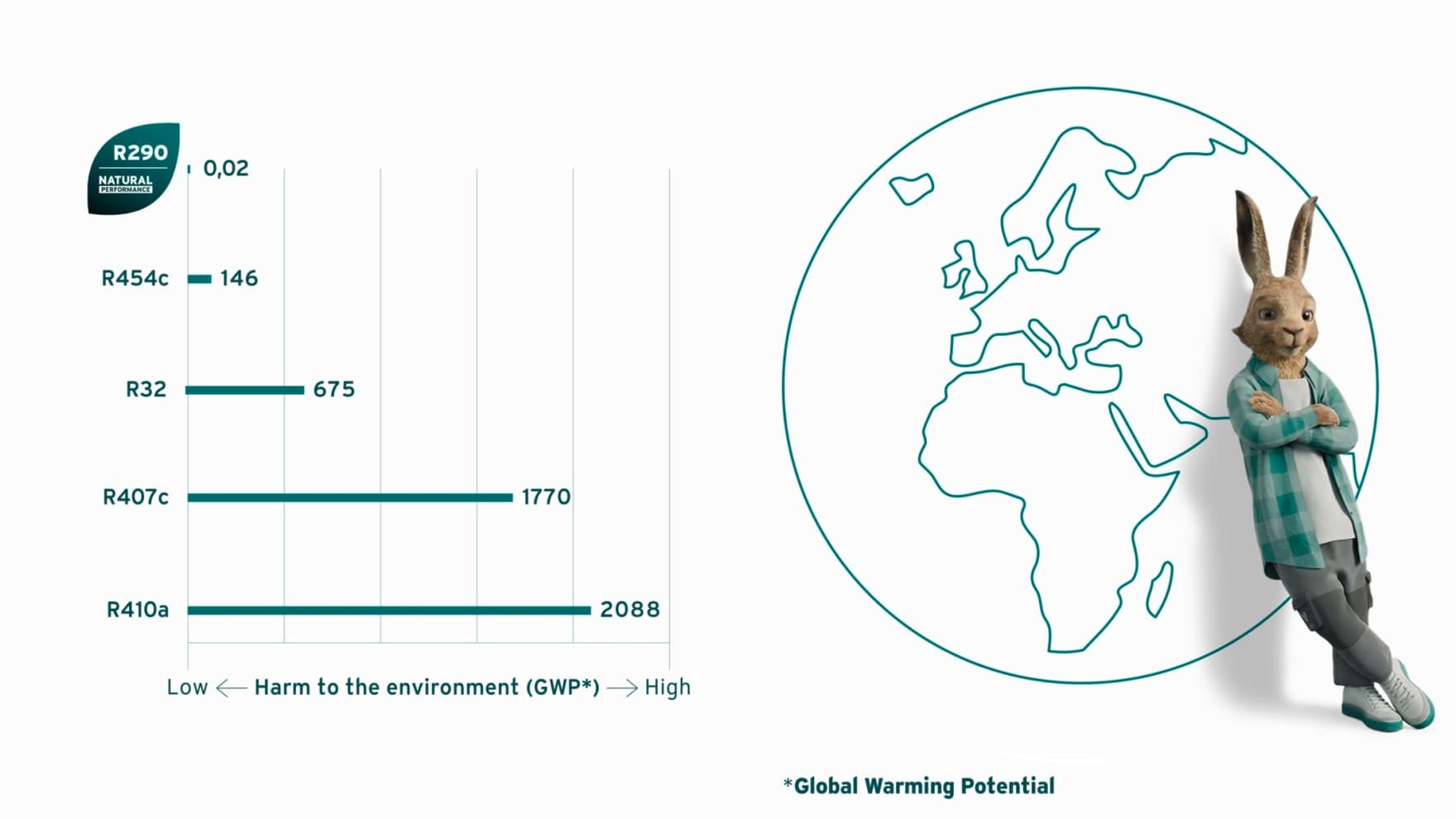
The global warming potential (GWP) is where natural and synthetic drift apart.
A crucial difference between synthetic and natural refrigerants is the Global Warming Potential (GWP).
GWP measures a substance's impact on global warming compared to CO₂, which has a GWP of 1. Higher GWP values mean greater harm. Synthetic refrigerants generally have a much higher GWP than natural refrigerants.
Key refrigerants for heat pumps.
| Refrigerant | Type | Key Applications | Environmental Impact | Key Points |
|---|---|---|---|---|
| R410A | HFC Blend | Residential and commercial heat pumps | No ozone depletion, high GWP | More efficient than older refrigerants, commonly used in modern heat pumps. |
| R744 (CO₂) | Natural Refrigerant | Heat pumps, supermarkets | Very low GWP, high pressure | Sustainable, non-flammable, requires robust system components. |
| R290 (Propane) | Natural Refrigerant | Small commercial heat pumps, AC | Very low GWP, flammable | Eco-friendly and efficient, requires safety measures due to flammability. |
The future of refrigerants.
Currently, all refrigerants can be freely used in heat pumps, but the trend is moving towards banning synthetic refrigerants with high GWPs. In the future, it will no longer be possible to market these high-GWP refrigerants. Find out more about the f-gas regulation and what it means for your heating.
But no reason to worry for you, with Vaillant you can relax! As we constantly work towards being one step ahead, our newest generation of heat pumps is ready for a sustainable future.